


Can AI do the due diligence on a fund or a deal for you? It can do some of the reading. But you still have to decide whether the investment is any good.
Below, you'll see where due diligence fits in an investment decision and how accurate AI is on financial documents. Then we'll look at one real fund's small print on fees and getting your money out. At the end, there's a prompt you can try on a fund you already know.
AI is becoming part of our everyday life and business operations, and founders in particular use AI agents more and more to automate their workloads and support the decision-making process. I am the same. I am building my personal AI-enabled operating systems and adding agents to support various workflows.
While AI can help me to do certain tasks 5 or 10 times faster, it doesn't mean I have more free time. Quite the opposite. I am even busier than I was, but I can do 5-10 times as much as I could before.
You may find the same. Researchers at UC Berkeley's Haas School of Business followed an American tech firm for eight months. People using AI worked faster and on a wider range of tasks, and their workday got longer.
As AI does a lot of work, it is easy to think it can make decisions for us and to trust those decisions. However, I think we need to be very cautious, as AI mistakes can be very costly.
Also, let's not forget that diligence comes only after we have made "a decision in principle" to invest in the fund or a deal, and its goal is to confirm whether it's "what it says on the tin".
This Week in 30 Seconds
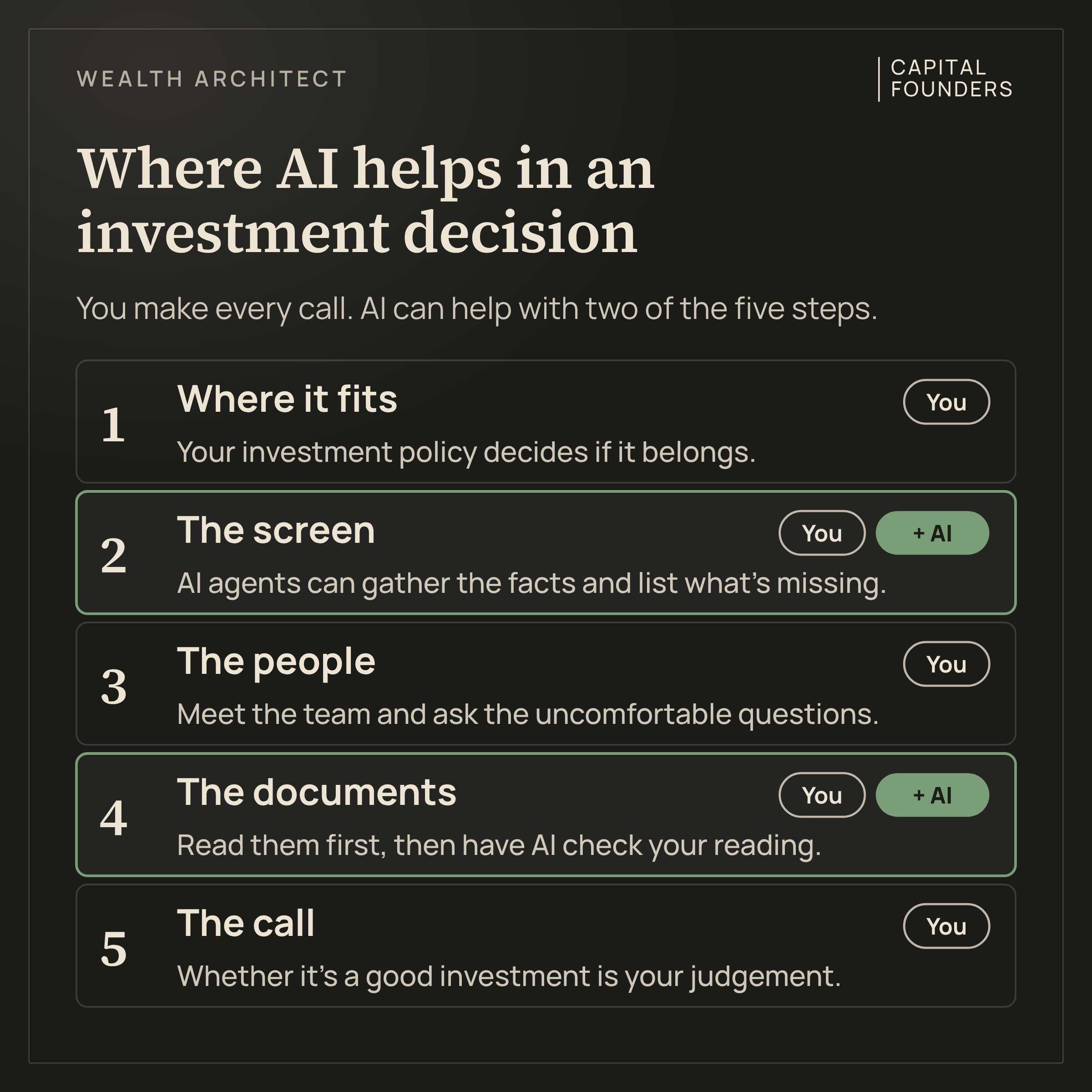
- Where due diligence fits. It comes after you've set your investment policy, sorted the pitches and met the team. It checks a fund or deal is "what it says on the tin".
- How far you can trust AI. In a 2026 test on SEC filings, human experts got 92% of questions right. The best AI model got 57%, even with the right passages in front of it.
- One evergreen fund's small print. You'd pay the manager 12.5% of the profits each quarter, once earlier losses are made up, and that can include gains on investments not yet sold. You could only sell when the fund offers to buy shares back. A traditional fund's manager is usually paid only from gains on investments already sold.
- How to use AI on it. AI agents can go through many pitches for you. When you get to the documents, read them first, then have the AI check your reading with the prompt below.
- What I'm reading. The Budget is on 28 October, and my take is to start preparing a sale 12–24 months ahead. A private fund's reported value (its NAV) is only an estimate. If your broker fails, administrators' fees come out before you get your money back. And there are four questions to ask before an AI tool gets into your accounts.
Where due diligence fits in an investment decision
First, you decide where a fund or deal fits within your portfolio. That's what an investment policy statement is for. You write down the returns you're aiming for, how far you'd let your portfolio fall, and how much you'd allocate to each asset class or deal.
Then you go through the pitches and decide which to look at further. Some of your reasons will be clear, like the manager's track record, and some will be blurry, like wanting to back someone you know well and respect.
If a fund gets through, you meet the team and ask questions, including uncomfortable ones. At the end of the day, it's a people business. Not everything will work perfectly, and it never works as the deck pitched.
After that, you get to the documents and the small print.
How far you can trust AI on fund documents
AI can help with that, but you also need to know what questions to ask. AI can never (at least not for now) judge whether it's a good or bad investment.
If you trust AI on the wrong task, you can end up worse off than if you hadn't used it. A 2023 Harvard Business School study showed this with Boston Consulting Group consultants. On a task the AI handled badly, those using it got the right answer less often than colleagues working without it.
People still read financial filings better than AI. In a paper this year, researchers from Yale, Goldman Sachs, UC San Diego and Tongji University tested 17 AI models on questions about company filings to the SEC.
- On questions about a single passage from a filing, human experts got 92% right.
- The best AI model scored 57%, even when given the passages with the answers.
- Four of the models were also left to find those passages themselves. The best of them got 26%.
If you've read the document, you can point the AI to the right pages and check what it returns.
Evergreen vs traditional funds: fees and getting your money out
You can't download the documents for a traditional venture capital or private equity fund. So take a public example: the prospectus a venture and growth fund filed with the SEC in April 2026.
It's an evergreen fund. It has no end date, and you can buy in any month starting at $25,000 if you qualify. You get your money out by selling shares back to the fund when it offers to buy them.
Here's how the manager gets paid in each kind of fund:
- In a traditional fund, you pay the manager a share of the profits, called carried interest. You usually pay it only on gains from investments the fund has sold, when it pays out the money.
- In this fund, you'd pay the manager 12.5% of the fund's net profits each quarter, once any prior losses are recouped. The fee is based on the increase in the fund's value, and that value includes estimates for investments the fund hasn't sold. So you could pay it on gains that exist only on paper.
If you only read the fee table, you'd see 0.00% for that fee in the first year. A footnote says it's left out because it's "speculative".
On top of that, you'd pay 3.29% to 4.04% a year, depending on which class of shares you buy. The cheapest class needs $1m. After a fee waiver, it's 2.93% to 3.68%.
That includes a 1.25% management fee and 0.53% in fees charged by the funds it invests in. Through those funds, you'd also pay their managers a share of the profits, generally 15–25%. The 0.53% doesn't include that.
In August, Evan Clark of the EDHEC Infrastructure & Private Assets Research Institute wrote that over 70% of the gains reported by US-registered evergreen funds since 2021 are still on paper. In some cases, he notes, if those gains later disappear, you don't get back the fees paid on them.
Getting your money out is different too:
- With a traditional fund, your money comes back as the manager sells investments, over ten years or more. Before then, the only way out is to sell your stake to another investor. That usually needs the manager's consent, and you often get less than the stake's stated value.
- In this fund, the manager plans to propose buyback offers of up to 2.5% of the fund's shares each quarter. But the board decides on each offer, and the fund may buy back fewer shares than you want to sell. If you sell shares you've held for less than a year, the fund can keep 2% of their value as a fee.
In the prospectus's words, aside from those buybacks, "investors generally should not expect to be able to sell their Shares regardless of how well the Fund performs."
What happens if a firm your fund relies on fails
The biggest challenge is indirect risk, which people sometimes don't even think about. What would happen in the worst-case scenario: how things would be dealt with.
You can ask that about every outside firm a fund relies on:
- The bank that holds its cash. Most of the funds Cambridge Associates looked at in its 2025 reviews had a single bank. Only 13% used more than one.
- Whoever keeps its books and works out how profits are split between investors and the manager. About half the managers in those reviews still did that in Excel or something similar, so ask who checks the numbers.
- Any insurer or lender.
You can ask the same about your own brokerage account. See the Jarvis Investment Management item in What I'm Reading below.
How to use AI to screen deals and check fund documents
If you actively allocate to funds or deals and have a big deal pipeline, you can automate the screening process. For example, tell your AI agents what information you need and to find it, and list where it is missing. That can be handy and will save you hours of reading.
You'll probably turn down most deals, and so do professionals. In a 2016 study surveying 885 venture capital investors, the typical firm backed about 1 in 100 deals it reviewed.
If you'd like a list to start from, you can give your AI agents the ILPA Due Diligence Questionnaire. It's the standard list of questions institutional investors ask fund managers. It covers the team, fund terms, track record, valuation and the outside firms a fund uses.
When a fund or deal gets through your screen, you move on to due diligence. If I use AI, I always read the document first, then give it to AI to analyse and compare notes. Sometimes it can point out things I overlooked.
But AI won't help you to understand if the strategy is good or not. That requires your own judgement. I wrote a piece on this topic: how to outsource operational work to AI but not the decision-making process.
To see how well your AI does, pick a fund or deal you've already made up your mind about. That way you know the answers. Then give the AI its documents with the prompt below.
If you ask for the exact words and let the AI say when something isn't covered, you'll get fewer made-up answers. Anthropic, the company behind the Claude models, recommends both for long documents.
I've read this document myself. For each question, give me the answer with the page and the exact words, or say it isn't covered.
- What am I buying, and what rights do I get?
- What will it cost me each year, including anything outside the fee table?
- Does the manager take a share of the profits, and is it worked out on investments sold or on valuations?
- How and when can I get my money out, and who decides?
- Who values the investments, and how often?
- Which outside firms does it depend on, and what happens if one fails?
Then list what it doesn't tell me, as questions for the manager or the company.
Then compare its answers with yours.
I would use AI as a second pair of eyes and a decision-making partner. But you can only outsource admin and operational work, not the thinking. Then you need to make a decision and make a call.
If there's a money question nobody has answered straight for you, reply, and the best ones go into the December edition.
Everything here is free. Subscribing just tells me the content is useful — and helps me decide what to write next.
What I'm Reading
UK Budget is on 28 October, with no tax changes announced yet.
You may have heard gains will be taxed at income tax rates, but nothing official says so. If you sell as a higher-rate taxpayer, you pay 24% on the gain. Up to £1m of gains that qualify for Business Asset Disposal Relief are taxed at 18%. Read the Chancellor's 15 October statement →
As Western governments run out of money, the easiest way to raise funds (and this is what we are seeing) is to raise taxes. That is a dumb move in my view; it never works, but it is what it is.
So that means preparation for sale is even more important, and something you should start thinking about 12-24 months ahead of the sale. Proper structuring, relocation if necessary and making all personal arrangements. If you don't put effort into it, it can cost you a lot of money. I am not against paying taxes, but when taxes get ridiculous, it's only natural for capital to flee.
SEC staff tell US funds to check the values managers put on private investments.
On 28 September, SEC staff told US funds that rely on a manager's valuation to look at "all reasonably available information". That can include the prices investors receive when they sell fund stakes to one another. In the first half of 2026, stakes in high-quality buyout funds sold for about 90% of the manager's stated value, according to Evercore. Read the statement →
NAV in private markets is very indicative, and you should use it for indicative purposes only. A secondary sale can indicate the real price, but remember there is also a liquidity premium.
Someone selling on the secondary market might need cash and can be willing to take less to get money faster. That doesn't mean the fund loses value.
Jarvis, which held shares and cash for several UK broker brands, is in special administration.
If your account is with x-o.co.uk, ShareDeal Active, or another broker that used Jarvis Investment Management, you haven't been able to buy, sell, or withdraw money since 14 October. If money or assets are missing and you're eligible, the Financial Services Compensation Scheme can cover you for up to £85,000. That includes the cost of recovering your assets. Read the FCA's notice →
Unfortunately, such things happen, and investment firms can go out of business. So if you are managing serious money, don't go for cheap options. You can pay more for better structures or for being with a larger firm. Never go with the cheapest option; the risk can be too high.
The good thing is that in highly regulated countries like the UK or the US, clients of investment firms are protected, so they usually get their money back even after a certain period.
The not-so-good news is that once an administrator is appointed, clients receive their money only after the legal and administrators' fees are paid, and those fees can be quite high (since these guys aren't that motivated to finish their job quickly).
An advisers' column lists four checks before an AI tool connects to an account.
Before you give an AI assistant access to your bank or brokerage account, ask the four questions in Brad Johnson's WealthManagement column:
- What can it see?
- What does it pass on?
- Where does your data end up?
- Can it change anything?
New on the Site
The 8 October article is about managing your own money if you hold $5M–$100M. You keep the decisions and bring in specialists and software for the rest. This week's memo is about one of those jobs: reading a fund document with AI.
Read it: Capital Founders OS: How Founders Run $5M–$100M Like a Business
This was Capital Signals — weekly briefings on what's reshaping founder strategy on wealth.
Go deeper: Playbooks · Wealth Architecture · Investment Strategy · Business Building · Life Design
Found this useful? Forward it to a founder who's thinking about this stuff. Got a question or disagree with something? Get in touch.
New here? Subscribe for one email a week.


