


For people outside the industry, hedge funds look like mysterious money-making machines with high returns and huge egos. The reality is far from that.
In practice, a hedge fund has a narrower job: to make money in a different way from the stock market, so your whole portfolio falls less when markets drop. In a strong year, that usually means trailing the market. And if you go in through your bank or wealth manager's feeder fund, you pay a second layer of fees on top of the fund's own.
On $1m over five years, those two layers can take almost half the gain. Below is what a hedge fund is for, how founders get in, what it costs, a feeder story that went badly wrong, and five questions to ask before you invest. At the end, I'll tell you where I stand.
This Week in 30 Seconds
- What a hedge fund is for. It's meant to give you returns that move differently from the stock market, so it often lags in strong years and loses less in bad ones: in 2022 the average fund lost 4.2% while a 60/40 mix of shares and bonds lost 16%.
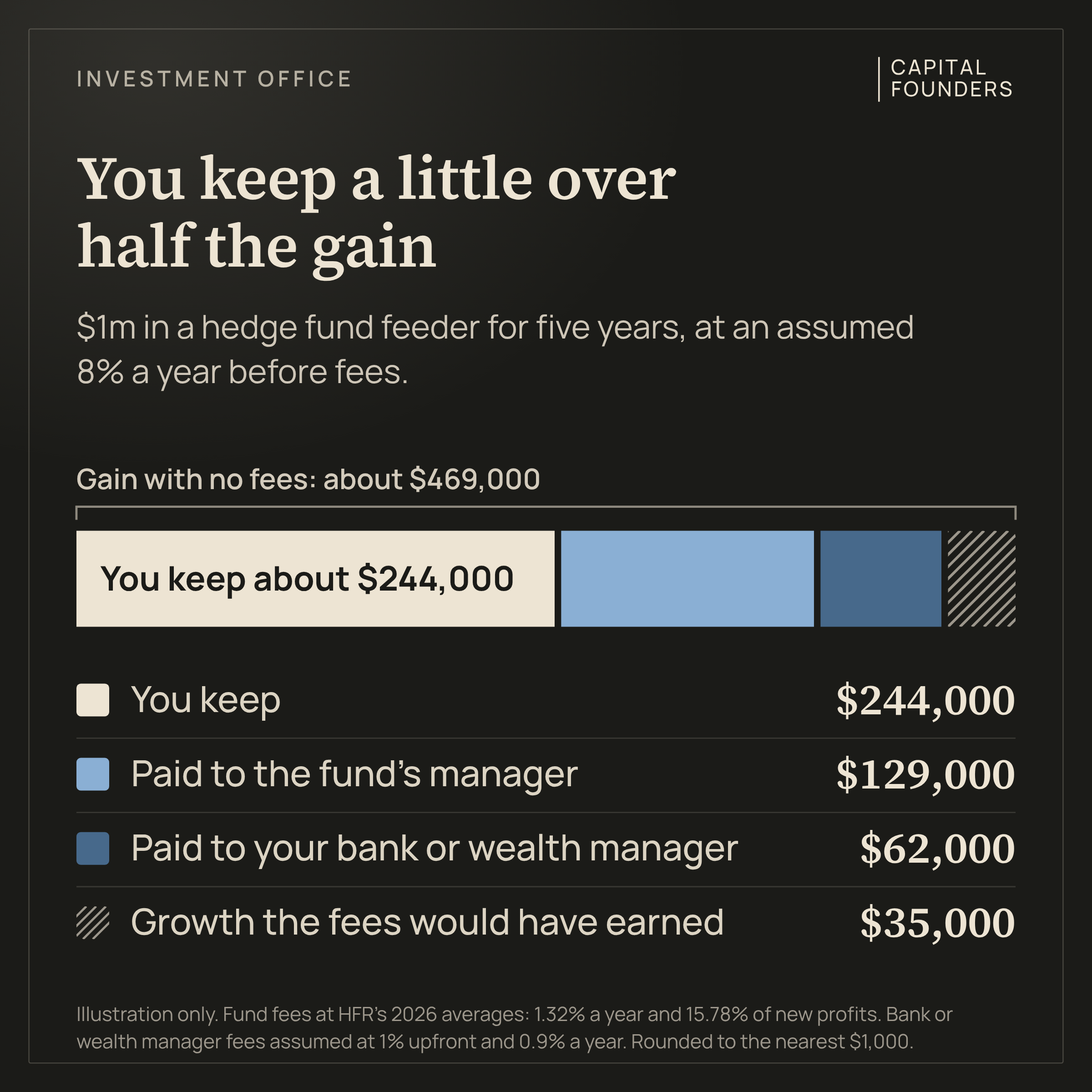
- What a fund feeder costs you. On $1m over five years at an assumed 8% a year, you'd keep about $244,000 of a $469,000 gain once the fund's fees and the distributor's come out.
- Five questions, and where I stand. The first is what can go wrong, under what circumstances and when. For me, hedge funds would probably be one of the last building blocks I'd consider for my portfolio.
- What I'm reading. Private credit can be useful if you understand how you'd get your money out, and taking some chips off the table is one way to turn paper wealth into real money. Also: what the IRS now says about swapping shares into an ETF, and a Texas family office that sued its chief investment officer.
What you get from a hedge fund in your portfolio
The number of strategies that fall under the "hedge funds" category is so large that it makes it even more complicated to understand it. Alfred Jones started the first hedge fund in 1949, buying shares with borrowed money and betting against others in case the market fell. Today the US regulator calls a hedge fund "a private, unregistered investment fund", open only to wealthier (accredited) investors.
Hedge funds can potentially make money in any market conditions, when markets are rising (through long positions) and when they are falling (through short selling). But it is also true that in certain market conditions, certain strategies will be making and some will be losing money. That is normal and these strategies are designed that way. In 2008, when US shares fell 37%, funds that buy some shares and bet against others lost about 27%, while algo funds that follow price trends made 18%.
While hedge funds are supposed to make money in any market conditions (depending on the strategy), their aim is to achieve uncorrelated returns when markets get choppy due to the manager's skill. So there could be a scenario where equity markets would be performing very well and hedge funds will be showing underperformance. And often that is supposed to be like that. On the other hand, when equity markets decline, many hedge funds can show better performance and minimise the overall drawdowns. There are certain strategies (like long volatility) that are specifically designed to perform very well in sharp market declines acting as protection for the overall portfolio.
In the average hedge fund you'd have made 9.8% in 2024 while US stocks returned 25%, and lost 4.2% in 2022 when a 60/40 mix of shares and bonds lost 16%. Long-volatility funds made 46% in 2008 and then went nowhere from 2012 to 2015, on a Cboe index rebuilt from past data. If you own one for protection, expect it to look like a bad investment most years (but think of it as insurance that should pay off in a sharp market sell-off).
How founders get into hedge funds: minimums, feeders and funds of funds
There are around 13,000 hedge funds reported to the US regulator alone, and most of them you have never heard of. There are some large funds that you can read about in the news but it is only the tip of the iceberg. Large hedge funds aren't always the best, and smaller funds can deliver outsized returns. A 2009 study found small funds beat big ones by 2.75% a year even allowing for risk, but a 2019 study found they shut down more often. Many hedge funds are boutique and low profile, so it's not easy to identify them or access information in the public domain.
Most of the hedge fund investors are institutional investors: pension funds, insurance companies, endowments, sovereign wealth funds. The minimum ticket usually starts at $1m, and can run to $10m at some of the largest funds. In my experience, the larger the fund, the larger the minimum ticket. It is also possible for a private investor to access huge funds directly but you probably need at least $1m (usually more) for them to start talking to you.
Through a feeder (usually offered by your private bank or wealth manager), which pools many clients' money into one hedge fund, you can go in from about $100,000. In the US, though, you generally need to own at least $5m in investments, even through a feeder, and in the UK you may need to be treated as a professional client.
One way to get exposure to different hedge fund strategies with a smaller ticket is a fund of funds. That is a fund that invests in hedge funds, and you can get exposure to a diversified hedge fund portfolio via one structure and with a smaller ticket.
Hedge funds fall under the definition of alternative investments, and allocation to alternatives among institutional investors or family offices ranges from about 10% to over 40% of the overall portfolio. Families in UBS's 2026 family office survey keep about 6% in hedge funds. But to have a diversified portfolio of hedge funds, you probably need to have $10–15m+ to be able to allocate to this asset class only. A 2002 study found you get most of the benefit of spreading with five or ten hedge funds, which at $1m to $1.5m each is $5m to $15m. If you have $25m, 6% is $1.5m, which gets you into one fund.
Hedge fund fees: what you pay on $1m over five years
Hedge funds typically come with higher fees. People usually think 2/20 (2% management fee and 20% performance fee on new profits, sometimes only above a certain hurdle rate) but I would say today fees are declining and it could be more like 1.5/15. HFR says the average fund now charges 1.32% a year and 15.78% of profits. There are some large funds that would charge 3/30 but they are an exception. Many hedge funds, especially the large multi-manager ones, also work on pass-through fees (on top of management and performance fees) meaning they will pass on the fees incurred by the fund directly to investors and it will eat into the performance. In 2023 one big multi-manager fund made 15.2% before fees and costs, and its investors kept 2.8%. So when evaluating the hedge funds always consider the impact of fees and compare net performance. You get what you pay for, and I would mostly focus on trying to understand if the value I am getting is worth the money. You pay for quality, and if the strategy makes money, it's OK to pay for it.
However, funds of funds come with an additional fee layer so understanding net performance and effect on your portfolio is important. With a feeder you also pay the distributor (private bank or wealth manager), upfront and every year. One big US wealth manager's filings say so, without the amounts. Say you put $1m in for five years, the fund's yearly return is 8% before fees, which are the averages above, and the distributor charges 1% upfront and 0.9% a year (the 8% and the distributor's fees are for illustration). Without fees you'd make about $469,000, and with both sets of fees you'd keep about $244,000, a little over half. You'd pay the fund's manager about $129,000 and the distributor about $62,000, and lose another $35,000 the fee money would have earned in the fund. Without these middlemen you'd keep about two-thirds, before any running costs the fund passes on.
What happened to investors in Madoff's feeder funds
Fairfield Sentry, Bernard Madoff's largest feeder fund, had more than 95% of its investors' money with him when the fraud came out in 2008. Clients of Santander's private bank went in through another feeder, and the bank set aside €500m to compensate them. Fairfield's investors alleged in court that it charged up to 3% upfront, about 1% a year and 20% of gains, and that it claimed a "higher level" of checking than other funds.
How a hedge fund is sold to you, and who gets paid
You may hear that HFR's index made 12.5% last year, but the best 10% of funds made 62.7% and the worst 10% lost 12.8%, so yours could end up far from 12.5%. I have seen many wealthy people invest in some sort of hedge fund strategy. They saw it not as a component of their overall portfolio, but as an investment opportunity where they could make high returns. They usually put too much money into a single strategy, and when the performance was not what they expected, they lost money and faith in the investment industry overall. They mistook one particular strategy for the portfolio approach to managing their money.
Hedge fund salespeople are OK to start the conversation with, but you always try to meet and speak with the chief investment officer or portfolio manager managing your money. The hedge fund's manager often pays the distributor too, on top of what you pay; one big US wealth manager's brochure says so. So when the next deck arrives, ask who is paying the person who sent it, and for what.
Five questions to ask before you invest in a hedge fund
- What can go wrong, under what circumstances and when?
- Where does it fit with the rest of my money, and what were its returns in 2022, when markets fell, and in 2024, when they rose?
- With every layer added up, what would I pay a year, and what return is left?
- Who gets paid when I buy it, and does that payment continue while I'm in?
- How soon could I get out, with how much notice, and can the fund stop withdrawals?
If one's in your inbox, try question 3 yourself: add up the fees as yearly percentages, spreading any upfront fee over the years you'd hold it, and ask for anything missing.
Where I stand. While hedge funds can definitely be a useful part of your investment portfolio, you really need to understand them well (and have a team who can do more thorough due diligence and selection) and have enough money to play that game. Earlier this year I met a family office that invests predominantly in hedge funds, and has some of the top names on the roster. But that is a family office where the founder gets $40m–$50m per year in dividends from the main business, so the scale they play at is very different. As for me, hedge funds would probably be one of the last building blocks I would consider for my portfolio.
So when others pitch you a hedge fund, don't fall into the trap of a bullish pitch. Hedge funds are a sophisticated investment strategy. You should also think about them in terms of return on time, like return on capital: the time and effort you need to spend learning about hedge funds against the return you get, compared with other areas where you can focus and make more money (even investing in businesses).
I am not saying founders should not consider hedge funds, but they are usually more complicated and require knowledge and skills. Also, the same investment goals can often be achieved with simpler portfolio construction, or by using options or other derivatives for hedging, for example.
But it is still important to understand what this asset class can do, what it can't and what its real purpose is in the portfolio.
Everything here is free. Subscribing just tells me the content is useful — and helps me decide what to write next.
What I'm Reading
Private credit investors asked for $4.2bn back.
Investors in two Blue Owl private credit funds for individuals asked for $4.2bn back last quarter, and each will buy back only 5% of its shares, split between everyone who asked. Read the story →
Private credit funds can be a useful instrument in your portfolio, providing income and diversifying risk. However, it is important to understand the liquidity profile and not get confused by marketing buzz. When considering investing in any asset class, always think of what will happen if something goes wrong. In that case you will be prepared, understand risk and can position your portfolio accordingly.
Tech billionaires' fortunes grew $845bn on paper.
Tech billionaires gained $845bn between January and September, by Bloomberg's count. But 75% of family offices in RBC and Campden Wealth's survey think AI is a bubble that will pop within five years. Read the report →
Paper money and real money are different things. You can be asset-rich and cash-poor, and asset prices can go up and down, especially in public markets or if your wealth is concentrated in growth stocks. One way to build wealth while building a company could be taking some chips off the table to build up your personal investment portfolio and cash cushion for when things can get tight.
IRS now treats some ETF swaps as taxable sales.
In the US, if you swap shares with big gains into a new ETF and the fund hands them to a dealer under one plan, the IRS now taxes the swap as a sale, and future rules could also apply to swaps already done. Read the ruling →
Today, in most Western countries, governments have huge deficits and are piling up debt. One of the few ways for them to raise more money is to increase taxes one way or the other. What yesterday looked like a "tax-efficient scheme" can turn out to be really expensive if the government changes its stance and starts looking into it in more detail. So while tax optimisation is important, don't try to cut corners and fall for the promises to reduce your tax bill using some "innovative financial product".
A Texas family office settled with its former chief investment officer.
A Texas family office let its chief investment officer go after under three months, then sued him, saying he made five investments nobody approved and overstated his wealth to borrow $15m from the family member whose money it runs. They settled on 23 September, and he disputes the claims. Before you give anyone the power to invest your money, write down which payments need your signature, and ask your bank and custodian to block any payment without it. Read more →
New on the Site
Last Thursday's article went on the site without an email, so you may have missed it. It lays out how to run your wealth like a business if you have $5M–$100M, with you as the owner across four areas of money and life. It also promised a closer look at each kind of investment you get pitched, and this hedge fund primer is the first.
Read it: Capital Founders OS: How Founders Run $5M–$100M Like a Business
This was Capital Signals — weekly briefings on what's reshaping founder strategy on wealth.
Go deeper: Playbooks · Wealth Architecture · Investment Strategy · Business Building · Life Design
Found this useful? Forward it to a founder who's thinking about this stuff. Got a question or disagree with something? Get in touch.
New here? Subscribe for one email a week.


