


Combined trading volume across prediction markets hit $44 billion in 2025, up from approximately $9 billion the prior year. The NYSE's parent company committed $2 billion to Polymarket. Federal Reserve researchers published a paper finding that Kalshi's prediction market data may outperform traditional derivatives and survey forecasts on key economic indicators. And federal courts in Ohio and Tennessee issued directly contradictory rulings on the same legal question within two weeks of each other.
That's the state of this market in early 2026: massive institutional investment, growing academic credibility, and regulatory chaos.
Whether this is early infrastructure for a new asset class or peak enthusiasm before a regulatory reckoning, I don't have a confident answer. But here's a framework for evaluating the space that treats the opportunity seriously without ignoring the substantial risks.
What's Inside
- Market scale and velocity: Combined trading volume hit $44 billion in 2025, up roughly 400% from the prior year. Platform valuations now exceed $20 billion combined, with weekly volumes surpassing $2 billion on Kalshi alone
- Platform equity: Maximum upside, maximum regulatory risk. Kalshi ($11B valuation) and Polymarket ($9B) remain private, requiring venture-style allocation capacity and comfort with binary outcomes
- Public proxies: Robinhood (HOOD), DraftKings (DKNG), ICE, and CME all have meaningful exposure. Prediction markets became Robinhood's fastest-growing product ever, generating $100M in annualised revenue and on pace for $300M
- Infrastructure plays: Data aggregation, APIs, resolution infrastructure, and market making serve whoever wins the platform war. Infrastructure investors sidestep the binary regulatory risk that platform equity carries
- Direct trading is negative-sum: Zero-sum before fees, negative-sum after. An entertainment expense unless you have genuine edge through domain expertise or algorithmic arbitrage
- Hedging may be the real opportunity: Institutional clients are seeking event-contract derivatives to hedge policy, regulatory, and operational risks. Enterprise demand could surpass retail speculation
- Regulatory landscape is fracturing: Federal courts are issuing contradictory rulings, states are filing lawsuits, and Congress is introducing competing legislation. A Supreme Court case now looks increasingly likely in the 2027-2028 term
- Sizing guidance: Venture-style allocation bucket. 1-3% of alternatives capacity for those with appropriate risk tolerance. Positions taken now are implicit bets on regulatory resolution
How These Markets Differ From Traditional Forecasting
The mechanism is straightforward: a contract pays $1 if an event occurs, $0 if it doesn't. The current price represents the market's implied probability. A contract trading at $0.65 means the crowd collectively believes there's a 65% chance the event will happen.
What makes this interesting isn't the binary structure—options traders understand contingent payoffs. It's what financial stakes do to information quality.
Polls carry no accountability. Respondents face zero consequence for inaccuracy. They might tell you who they think will win an election, but they have no skin in the game. Prediction markets penalise overconfidence directly. If I'm convinced an outcome is 90% likely and the market prices it at 60%, I can profit by buying—but only if I'm actually right. This mechanism forces participants to reveal genuine beliefs rather than preferences, hopes, or tribal loyalties.
The theoretical foundation traces to Hayek's insight about decentralised information aggregation: no single person knows everything, but market prices synthesise dispersed knowledge into usable signals. Prediction markets apply this logic to events rather than goods.
Two platforms dominate the current landscape, and the regulatory and operational differences between them create real tradeoffs for institutional participants.
Kalshi operates as a CFTC-regulated Designated Contract Market, treating event contracts as derivatives under federal oversight. The company raised a $1.1 billion Series E in December 2025 at an $11 billion valuation, led by Paradigm, with participation from Sequoia and a16z. Their distribution strategy emphasises integration with established financial infrastructure—partnerships with Robinhood, Coinbase, CNN, and CNBC bring event contracts to existing user bases. Weekly trading volume now exceeds $2 billion, with over 85,000 active markets.
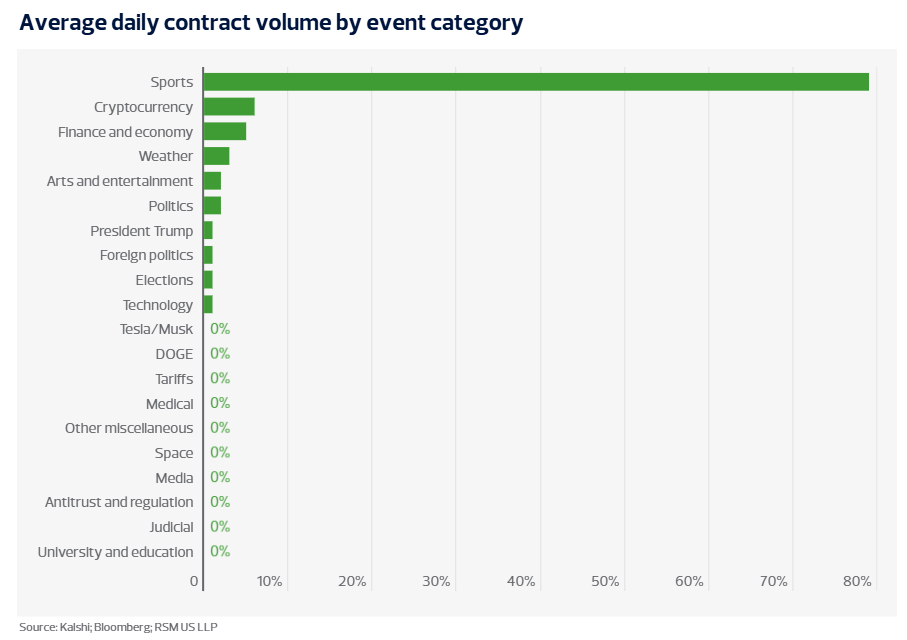
One detail worth noting: sports wagers now constitute an estimated 90% of Kalshi's trading volume and roughly 89% of the platform's revenue. The regulatory implications of that concentration become clear in the section on regulatory risk below.
Polymarket is built on blockchain infrastructure and originally offered global accessibility through crypto-settled contracts. U.S. users were blocked following a 2022 CFTC settlement, but the platform acquired QCEX, a CFTC-licensed exchange, for $112 million in mid-2025 and has received approval to relaunch domestically. ICE's $2 billion strategic investment valued Polymarket at approximately $9 billion and established ICE as the global distributor of Polymarket's event-driven data to institutional investors.
Kalshi offers institutional trust and compliance infrastructure at the cost of some market diversity and speed. Polymarket offers global reach and arguably purer information signals—including from participants who might have inside knowledge—but carries residual regulatory uncertainty from its crypto origins. Both platforms have demonstrated substantial traction and institutional backing.
Accuracy Record: What the Data Shows
The 2024 U.S. presidential election was the highest-profile test of prediction market accuracy, and the results merit careful examination.
Polymarket showed Trump as the favourite through most of the campaign, with probabilities that moved dynamically in response to events. When the first assassination attempt occurred in July, Trump's odds climbed immediately. When Kamala Harris entered the race, they dropped. When Harris performed well in the September debate, the market reflected that within minutes. Traditional polls remained essentially static throughout—hovering around 50-50 regardless of campaign developments.
Researchers at UCLA Anderson found that prediction markets provided nearly immediate feedback, responding faster than polls to debates, breaking news, and economic data releases.
But the accuracy advantage needs qualification.
A study by Vanderbilt researchers analysed over 2,500 prediction markets across four platforms during the 2024 election and found significant inefficiencies. Prices for identical contracts diverged across exchanges. Daily price changes were weakly correlated across platforms. Arbitrage opportunities persisted right up to election day—a sign that information wasn't being efficiently synthesised across the ecosystem.
The accuracy findings were nuanced: PredictIt correctly predicted outcomes better than chance 93% of the time. That figure dropped to 78% on Kalshi and 67% on Polymarket. The study's authors attributed PredictIt's higher accuracy partly to its bet-size caps, which discouraged massive "whale" positions and favoured a larger number of smaller, more deliberate participants.
The Iowa Electronic Markets, which have been running since 1988, offer the longest track record. Research published in the International Journal of Forecasting found that their election-eve predictions averaged 1.33 percentage-point absolute error, compared to 1.62 for polls conducted in the same window. Markets maintain this accuracy advantage even 100 days before elections, when polls are notoriously unreliable due to preference volatility.
Internal corporate prediction markets tell a similar story. Hewlett-Packard experimented with employee prediction markets from 1996 to 1999 and found they outperformed official corporate forecasts in six of eight cases. Google ran extensive internal markets with over 175,000 predictions from 10,000+ employees. The forecasts proved accurate and decisive, delivering useful predictions on everything from product launch timing to COVID-19 outcomes.
A February 2026 Federal Reserve paper added institutional weight to these findings. Researchers found that Kalshi markets may outperform traditional derivatives and survey forecasts on key economic data, with a perfect forecast record on Fed rate decisions the day before FOMC meetings. The paper noted that prediction market prices update in real time, unlike surveys released periodically—a structural advantage for anyone making time-sensitive capital allocation decisions.
Prediction markets aggregate information efficiently and update more quickly than alternatives. They cannot predict truly unknowable events, and thin liquidity can create opportunities for manipulation. More volume doesn't automatically mean more accuracy—market structure and participant composition matter. For investors evaluating the space, the accuracy proposition is real but modest. The more compelling thesis involves what happens when this infrastructure scales and whether institutions adopt prediction market data as a standard input for decision-making.
Everything here is free. Subscribing just tells me the content is useful — and helps me decide what to write next.
Five Approaches to Exposure
The menu for gaining exposure has expanded considerably over the past eighteen months. Each approach carries distinct risk characteristics and return profiles.
Platform Equity
Kalshi and Polymarket remain private companies despite their massive valuations. Access requires either direct relationships with their investors or participation in secondary markets where shares occasionally trade.
The investment case rests on prediction markets becoming a mainstream asset class. Citizens Financial Group projects industry revenues will grow 5x to over $10 billion by 2030. Some industry projections suggest trading volume could reach $1 trillion annually by decade's end. If these projections materialise, early equity holders would benefit enormously—Kalshi's December valuation of $11 billion implies the market is already pricing significant growth.
The risk is equally substantial. Regulatory resolution could go either direction. A Supreme Court ruling affirming state authority over event contracts would force fundamental restructuring. Platform valuations would compress, and the unified national market these companies have built would fragment.
For allocators with venture capacity, this resembles early crypto exchange equity circa 2017-2018. Coinbase shares were accessible only through private markets before the 2021 IPO. Those who gained exposure saw extraordinary returns. Many similar bets went to zero. Position sizing should reflect this potential for a binary outcome.
Public Market Proxies
Several publicly traded companies offer indirect exposure without the binary risk of private platform equity.
Robinhood (HOOD) integrated Kalshi contracts directly into its trading app, and the results have been striking. Prediction markets became Robinhood's fastest-growing product line by revenue in company history, with 11 billion contracts traded by more than 1 million customers. The business has already brought in $100 million in annualised revenue, and based on October figures, is on pace to become a $300 million business. Robinhood has driven more than 50% of Kalshi's total trading volume, and the company recently acquired its own CFTC-regulated exchange to reduce its dependence on third parties.
DraftKings (DKNG) moved aggressively into the space in late 2025, acquiring Railbird Exchange—a CFTC-licensed futures exchange—and launching DraftKings Predictions in 38 states. At launch, trades route through CME Group, giving that exchange exposure to prediction market infrastructure as well. DraftKings brings substantial distribution advantages: an existing user base comfortable with event-based wagering, brand recognition, and regulatory relationships across multiple states.
Intercontinental Exchange (ICE) committed $2 billion to Polymarket. The parent company's strategic investment of this magnitude in the New York Stock Exchange signals institutional conviction in the category's future. ICE's involvement also means integration with traditional financial infrastructure—the agreement makes ICE a global distributor of Polymarket's event-driven data, providing institutional clients with real-time sentiment indicators on market-moving events.
Interactive Brokers (IBKR) has begun offering event contracts, expanding access to their institutional and sophisticated retail client base.
The advantage of public proxies is liquidity and diversification. These companies have revenue streams beyond prediction markets, so exposure is diluted, but so is risk. Prediction market success may represent only a portion of their total business—material enough to matter at the margin but unlikely to drive transformative returns unless the category scales dramatically. For founders already comfortable with building and managing a diversified investment portfolio, public proxies fit naturally into the alternatives allocation.
Infrastructure: Picks and Shovels
The thesis that worked in previous market emergencies applies here. When everyone's digging for gold, sell shovels.
Dome, backed by Y Combinator and founded by former Alchemy engineers, is building a unified API across Polymarket, Kalshi, Myriad, and Manifold. As the ecosystem fragments across platforms, infrastructure that aggregates data and enables cross-platform trading becomes essential. Hedge funds and market makers need consistent data feeds and execution capabilities regardless of which exchange ultimately dominates.
Data and analytics providers represent another infrastructure opportunity. The sports betting industry spawned Sportradar and Genius Sports—companies that broker game data and provide odds modelling to sportsbooks. Prediction markets have analogous needs for data feeds and predictive algorithms, but the equivalent infrastructure doesn't yet exist at scale. Institutions will pay for tools that systematically price the probability of a Federal Reserve rate cut or a corporate acquisition.
Resolution infrastructure deserves attention. Trustworthy event resolution isn't trivial, particularly for subjective or contested outcomes. The "Maduro trade" that drew headlines in January 2026 highlighted this—Polymarket initially hesitated to pay out "Yes" bets when U.S. forces captured the Venezuelan president, sparking accusations of arbitrariness. Platforms that solve verification problems elegantly create defensible value.
Market making itself functions as infrastructure. Susquehanna International Group and Jane Street dominate institutional market making on Kalshi, ensuring liquidity for contracts that would otherwise be too thin for professional use. The average trade size has evolved from $300 in early 2024 to nearly $4,800 today, reflecting institutional participation. Algorithmic trading firms are hiring specialists at $200,000+ salaries to build positions in this space.
Infrastructure offers exposure to the growth of prediction markets without direct regulatory risk. If Kalshi wins the platform war, infrastructure companies serve Kalshi. If Polymarket wins, infrastructure serves Polymarket. If DraftKings or CME emerges as a dominant player, infrastructure still gets paid. For risk-adjusted returns, this layer may prove most attractive for allocators uncomfortable with binary platform outcomes.
Direct Trading
Prediction markets are zero-sum before fees and negative-sum after. This basic math shapes everything about the opportunity for individual traders.
Unlike equity investing, where companies create value through productive activity, and shareholders participate in that creation, prediction markets merely redistribute wealth among participants. For every winner, there is a corresponding loser. The platforms extract fees through bid-ask spreads and transaction costs, resulting in an aggregate outcome that is negative for traders as a group.
The "Maduro trade" illustrates both the opportunity and its limits. A Polymarket user reportedly netted approximately $400,000 by betting on Nicolás Maduro's capture hours before international news outlets confirmed it, turning roughly $32,000-$34,000 in wagers into a massive payout. Whether this reflects remarkable analytical skill or actual inside knowledge is debatable. What's clear is that the trader had an informational edge that the market hadn't yet priced.
Algorithmic arbitrage strategies have generated documented profits by exploiting 4-6 cent price spreads between platforms for events expiring within 24 hours. These opportunities are fleeting and systematically captured by automated bots capable of executing trades in milliseconds. Manual traders cannot compete in this high-frequency environment.
On the regulatory side of direct trading, the rules are evolving rapidly. Prediction markets exist in a grey area between securities regulation and commodities law. Historically, insider trading prohibitions that apply to stock markets didn't clearly extend to event contracts. That's changing. In February 2026, the CFTC's Division of Enforcement issued a formal advisory documenting two insider trading enforcement cases on Kalshi—one involving a political candidate who traded on his own candidacy, another involving a YouTube channel editor who traded on material non-public information about upcoming video content. The CFTC stated it has "full authority to police illegal trading practices" on prediction markets, including misappropriation of confidential information under Section 6(c)(1) of the Commodity Exchange Act.
For participants with genuine domain expertise, such as healthcare regulation, energy policy, sports analytics, and geopolitical risk, there may still be an informational edge worth pursuing. But the regulatory ground is shifting. For most individual investors without a systematic edge, direct trading should be sized as an entertainment expense rather than a wealth-building activity.
Hedging Applications
The most legitimate use case for sophisticated allocators may be hedging rather than speculation.
Consider concrete applications:
- A crypto-focused fund with regulatory exposure can use prediction market contracts on SEC enforcement outcomes to hedge portfolio risk directly—far cleaner than constructing synthetic positions through traditional derivatives
- A logistics company can monitor blockage probabilities for shipping chokepoints and adjust routing or inventory accordingly
- Energy companies can hedge climate policy changes by taking positions on specific regulatory outcomes
- Pharmaceutical companies can hedge drug approval timelines, adjusting R&D spending or partnership negotiations based on market-implied probabilities
Goldman Sachs has noted that institutional clients are seeking "event-contract derivatives" cleared through regulated exchanges to hedge macro risks. Hedge funds are using these platforms as a VIX alternative, deploying prediction markets to hedge against specific news risks such as CPI prints, Federal Reserve rate decisions, and regulatory changes.
Enterprise demand for hedging instruments may ultimately exceed retail speculation in scale and stability. A major logistics firm monitoring "Suez Canal Blockage Risk" markets to decide whether to reroute ships represents a shift from prediction markets as entertainment to prediction markets as operational infrastructure.
Regulatory Landscape
No honest assessment of this space can skip the central uncertainty: the legal status of prediction markets is actively being contested in courtrooms, statehouses, and Congress simultaneously—and the rulings so far directly contradict each other.
The core legal question: Are prediction markets CFTC-regulated financial derivatives, subject to federal oversight and preempting state authority? Or are they state-regulated gambling products, requiring licenses in each jurisdiction and potentially facing prohibition in states that don't permit certain forms of wagering?
Kalshi has staked its business model on federal preemption. The company operates as a CFTC-regulated Designated Contract Market and has expanded into all 50 states, arguing that federal derivatives regulation supersedes state gambling laws. This position has met fierce resistance—and the resistance is winning as often as it's losing.
Federal courts are issuing contradictory rulings. In late February 2026, a Tennessee federal judge sided with Kalshi, ruling that its sports-event contracts are federally regulated and that the state could not require compliance with state gambling laws. Two weeks later, on March 10, a federal judge in Ohio reached the opposite conclusion. Judge Sarah Morrison ruled that Kalshi's sports contracts are gambling, not swaps, calling the platform's classification "absurd." She wrote that swaps involve financial instruments that affect commodity prices—"currency exchange rates, the weather, and energy costs all do that; the number of points scored in the Huskies-Bobcats game does not."
These contradictory rulings create exactly the kind of circuit split that leads to Supreme Court review.
State opposition has intensified. More than 30 states have filed amicus briefs supporting state regulatory authority over event contracts. Nevada, New Jersey, and Maryland have moved to block Kalshi's sports contracts specifically. The Massachusetts attorney general sued Kalshi in September 2025, and a preliminary injunction in January 2026 barred certain contracts in that state. Nevada won a ruling dissolving Kalshi's preliminary injunction, and Robinhood agreed to cease offering new sports event contracts there.
Tribal gaming interests have entered the fight. The Ho-Chunk Nation filed suit in Wisconsin. The tribal gaming industry views prediction markets as direct competition and has meaningful political influence in multiple states.
Congress is introducing competing legislation. The Torres Bill (H.R. 7004), introduced in January 2026, would prohibit government officials from trading prediction market contracts when they possess material non-public information—essentially extending STOCK Act principles to event contracts. It has over 30 Democratic co-sponsors but no Republican backing. Separately, in March 2026, Democratic senators Blumenthal and Kim introduced legislation that would ban insider trading on prediction markets, restrict users under 21, and explicitly affirm state oversight authority—a more aggressive approach than the Torres Bill.
The CFTC is asserting federal authority. In response to the state lawsuits, the CFTC countered with a February 2026 advisory emphasising the "federal oversight framework" and prediction markets' "self-regulatory obligations." The Trump administration has also reiterated its defence of prediction markets.
Timeline markers for allocators: The Torres Bill has had a committee hearing, but passage odds remain low—prediction markets price it at roughly 12%. The Ohio and Tennessee cases will reach appellate courts by late 2026. A Supreme Court case, if it materialises from the circuit splits, would likely be decided in the 2027-2028 term. This suggests 12-24 months before definitive regulatory clarity emerges.
For allocators, the regulatory landscape creates both risks and opportunities. A definitive ruling against federal preemption would force industry restructuring. Given that sports contracts account for roughly 90% of Kalshi's current volume, state-level sports gambling regulation could directly impair its dominant revenue stream. Platform valuations would compress. The unified national market that Kalshi has built would fragment.
The flip side: regulatory barriers create moats for well-capitalised, legally sophisticated players. If federal preemption ultimately prevails, early movers will have established dominant positions that later entrants cannot easily challenge. The current uncertainty is precisely why platform valuations haven't already reached $100 billion.
Everything here is free. Subscribing just tells me the content is useful — and helps me decide what to write next.
Enterprise Opportunity
Most coverage focuses on consumer trading—individuals betting on elections, sports, and cultural events. The less visible but potentially larger opportunity involves enterprise applications.
Internal corporate prediction markets have a longer history than most realise. Google launched its internal market ("Prophit") in 2007, allowing employees to bet with play money on outcomes such as product launch dates, strategic milestones, and office openings. Over eight quarters of operation, the market delivered accurate predictions, surfacing information that management wouldn't have accessed through traditional channels.
HP, Microsoft, Intel, Eli Lilly, Pfizer, Qualcomm, and Siemens all experimented with similar systems. The consistent finding: markets outperformed traditional forecasting methods.
Why haven't they achieved widespread adoption? Analysis of Google's experience reveals a telling answer. The markets failed to scale not because they were inaccurate but because managers preferred plausible deniability when projects failed. Transparent probabilistic forecasts created accountability that executives found uncomfortable. The forecasting process served functions beyond accuracy—resource allocation negotiations, political cover for uncertain decisions, and coordination among teams. A more accurate but less politically flexible system threatened those functions.
What's changed is that external platforms now provide infrastructure without requiring internal political battles. A corporate treasury team can monitor publicly traded contracts on economic indicators, regulatory outcomes, or competitor milestones without building internal markets or navigating organisational resistance. The forecasting intelligence becomes a purchased input rather than an internal initiative requiring executive sponsorship.
Institutions increasingly view prediction markets as consensus pricing tools—mechanisms for aggregating distributed information into actionable signals. Anthropic recently announced an internal prediction market with an explicit "focus on decision-makers," a signal that sophisticated technology companies continue finding value in collective forecasting.
For founders with enterprise software experience, the gap is concrete. Tooling for corporate use of prediction market data doesn't exist at scale:
- Compliance wrappers for regulated industries (financial services, healthcare, government contractors) that need audit trails and governance frameworks
- Integration layers connecting prediction market data to SAP, Oracle, and other enterprise planning systems
- Vertical applications that translate raw probability signals into industry-specific decision support—demand forecasting for retail, clinical trial planning for pharma, policy risk assessment for multinationals
The platforms are building consumer products. The enterprise layer remains largely unconstructed. This resembles the early SaaS opportunity around Salesforce or AWS: foundational infrastructure exists, but vertical applications that make it usable for specific industries haven't been built yet. If you're evaluating the broader landscape of alternative investment strategies, the enterprise prediction market layer is one worth watching.
Risk Framework
The risks are substantial, correlated, and in some cases non-diversifiable.
Regulatory risk dominates. The contradictory federal court rulings described above make this abundantly clear. A definitive ruling against federal preemption would force industry restructuring. With sports contracts representing roughly 90% of Kalshi's trading volume, states hostile to gambling could impair the dominant revenue stream overnight. Platform valuations would compress dramatically, and infrastructure investments predicated on a unified national market would face impairment.
Competitive dynamics present concentration risk. Network effects in trading platforms typically produce winner-take-most outcomes. Liquidity begets liquidity—traders go where other traders are. Kalshi and Polymarket currently dominate, but DraftKings has meaningful distribution advantages through its existing user base, and traditional exchanges like CME Group have infrastructure capabilities that startups cannot match. Robinhood's acquisition of its own exchange introduces another well-capitalised competitor. Today's leaders are not guaranteed tomorrow's winners.
Platform execution risk is real. In January 2026, Kalshi initially refused to pay full winnings on certain correct NFL positions—only reversing after significant public backlash. For an industry asking users to trust platform integrity, operational mistakes like this erode confidence precisely when it matters most. Resolution disputes, as seen in the Maduro trade on Polymarket, compound this concern.
Manipulation risk shouldn't be dismissed. Large traders can move thin markets, potentially exploiting retail participants or creating artificial price signals. The Vanderbilt study found that arbitrage opportunities persisted even in the final weeks before the 2024 election—a sign that sophisticated actors weren't efficiently correcting mispricings. As institutional capital enters, the incentives for manipulation increase alongside the sophistication of defensive measures.
Volume sustainability is uncertain. The 2024 election and 2025 NFL season drove extraordinary trading volumes. What happens in 2027, when no presidential election dominates attention? Sports may provide baseline volume, but the category-defining events that generate massive liquidity are inherently episodic. Platforms need to demonstrate sustainable engagement between major events. Piper Sandler anticipates over 445 billion contracts will trade in 2026, but that projection depends on continued regulatory tolerance.
Market structure creates headwinds. Prediction markets are zero-sum by design. Sustained participation requires a continuous influx of new traders willing to take the other side of informed positions. If sophisticated algorithmic players increasingly dominate, retail participation may decline, creating liquidity problems. This dynamic has played out in other trading markets and could repeat here.
I've taken a small position in one infrastructure company—small enough that being wrong won't matter, large enough that I'll pay attention to developments. That sizing logic reflects how I think about venture-style allocations in uncertain categories: meaningful optionality, acceptable downside.
Framework for Allocators
The industry sits at an inflexion point. Regulatory clarity may emerge in 2026 or 2027, either through legislative action or definitive court rulings. The 2026 FIFA World Cup, hosted in North America, will test infrastructure at an unprecedented scale. Institutional adoption is accelerating, but remains early; most family offices and wealth managers have not yet allocated to this category.
Early positioning creates optionality value. Waiting for certainty means paying certainty pricing. The question is whether the current risk/reward compensates appropriately for regulatory uncertainty.
On sizing: This belongs in a venture-style allocation bucket—not in the core portfolio, not in income-generating holdings. One to three per cent of alternatives capacity is reasonable for allocators with appropriate risk tolerance. Those requiring greater certainty or shorter time horizons should wait for regulatory resolution. For a broader framework for sizing across asset classes in uncertain conditions, the Investment Philosophy Playbook covers the principles in detail.
On selection: Infrastructure offers the most attractive risk-adjusted positioning for most allocators. The platforms bear litigation costs while infrastructure companies get paid regardless of which platform wins. Public market proxies provide liquid exposure with limited downside. Platform equity demands comfort with binary outcomes.
On usage: Even without investing, prediction market data has value. Monitoring probabilities on economic indicators, policy outcomes, or sector-specific events provides a real-time signal that can inform investment decisions across the portfolio. Goldman Sachs has begun integrating prediction market data into client briefings. Google tested displaying market probabilities directly in search results. The information layer may prove valuable regardless of whether the investment layer generates returns.
Four questions can guide individual allocation decisions.
Do you have venture allocation capacity and genuine risk tolerance for binary outcomes? If platform equity goes to zero, will that impair your financial position or merely represent an acceptable loss in a diversified alternatives portfolio?
Do you have domain expertise in any event category? Healthcare regulation, energy policy, sports analytics, geopolitical risk? Domain knowledge creates an edge in evaluating which infrastructure or trading opportunities might succeed—and potentially in trading directly.
Are you willing to actively monitor regulatory developments? This space requires ongoing attention. Positions that made sense pre-ruling may need adjustment post-ruling. Passive allocation isn't well-suited to a category in which federal courts issue contradictory rulings every few weeks.
Can you accept that early infrastructure bets often fail even when the category succeeds? Many crypto infrastructure companies from 2017-2018 no longer exist despite the broader category's growth. Prediction market infrastructure will likely follow similar patterns—some massive winners, many failures. For founders evaluating venture-style allocation opportunities more broadly, the comparison with private equity and club investing structures is worth considering.
What Happens From Here
We're watching something interesting emerge. Whether information finance—markets that price truth rather than assets—becomes a permanent feature of the financial landscape depends on regulatory, competitive, and adoption factors that remain genuinely uncertain.
The institutional signals are worth noting. The parent company of the New York Stock Exchange doesn't commit $2 billion to passing fads. Wall Street firms don't hire specialists at $200,000 salaries for curiosity projects. The Federal Reserve doesn't publish papers validating forecasting tools it considers irrelevant. Something substantive is happening.
At the same time, federal judges are calling the classification of sports contracts as swaps "absurd." Thirty-plus states have filed amicus briefs. Class action lawyers have filed gambling lawsuits. Senators are introducing legislation to affirm state oversight authority. The resistance is equally substantive.
The next 12-24 months will determine whether this becomes foundational financial infrastructure or a regulatory casualty. I don't know which outcome will prevail.
What I do know: corporations are beginning to use prediction market probabilities for operational decisions—routing shipments, timing capital allocation, assessing policy risk. Whether you invest in the platforms, the infrastructure, or nothing at all, start paying attention to what these markets are telling you. The institutions that already have the analytical resources most of us lack.
Capital Founders OS is an educational platform for founders with $5M–$100M in assets. Frameworks for thinking about wealth — so you can make better decisions.
Explore more: Playbooks · Capital Signals · Wealth Architecture · Investment Strategy · Business Building · Life Design
Found this useful? Forward it to a founder who's thinking about this stuff. Got a question or disagree with something? Get in touch.
New here? Subscribe for one email a week.


