


A lot of what founders read about AI and wealth comes from people selling software, apps and platforms, and the message is that you need AI to manage your wealth. Before you rely on any of it, be clear what you'd use AI for, and ask whether the tool will still be around in two years.
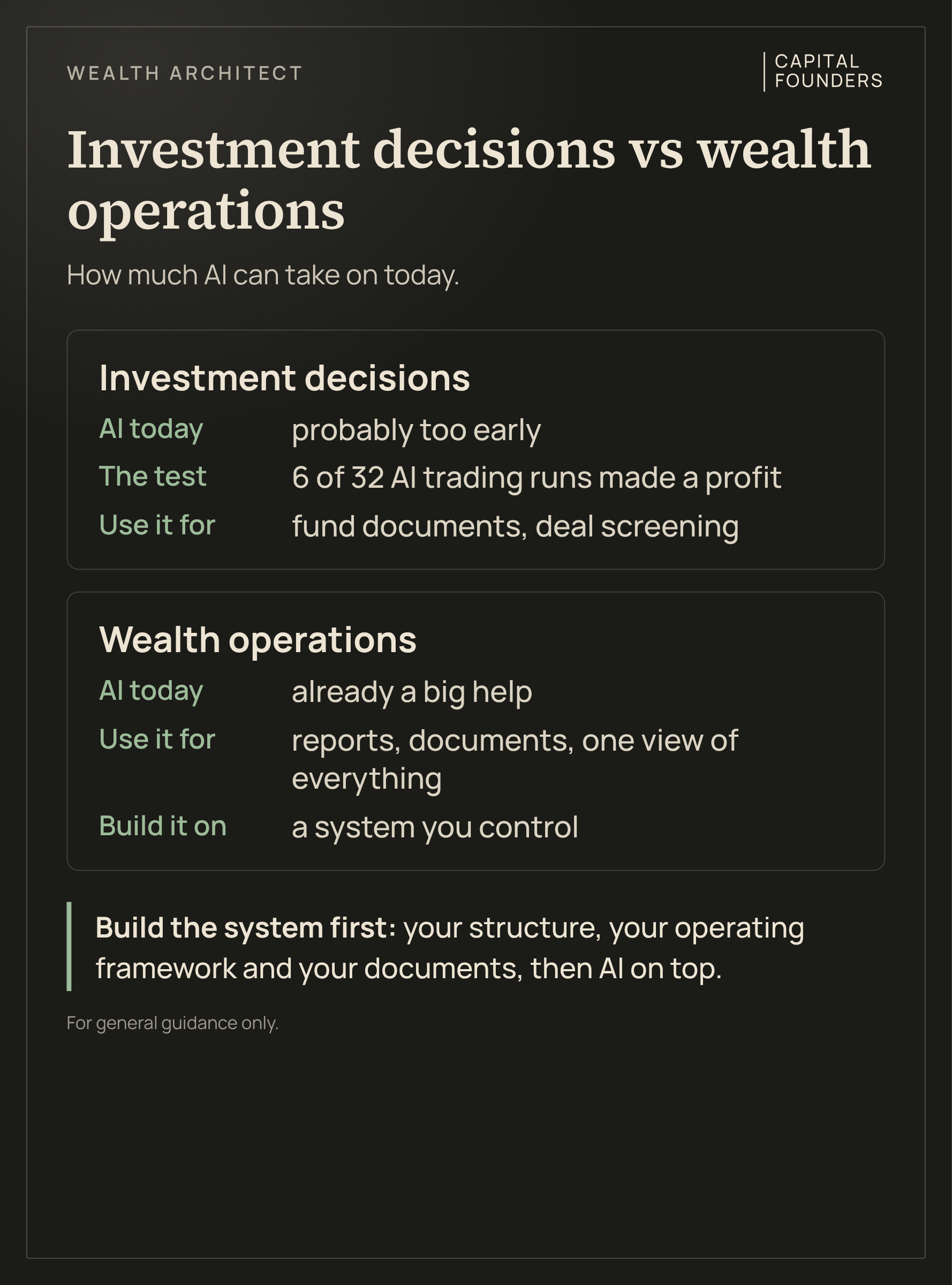
For investment decisions, it's probably too early. For running your wealth as an operation, AI already helps a lot, as long as it works on a system you control.
This Week in 30 Seconds
- AI isn't ready to make investment decisions. In four trading contests for AI models, only 6 of 32 runs made a profit. For research, reporting and documents, it already helps.
- New AI tools and providers come and go. Be careful about building your wealth operations around one, and ask three questions first.
- Build the system first. Map your entities, accounts and platforms, set up your operating framework and document storage, then use AI on it, as I did for my own.
- What I'm Reading. Schwab's AI trial, OpenAI's second go at AI payments with my view on agents, and new models from OpenAI and Google.
Is AI ready to make investment decisions?
Not yet. Bloomberg reported in May on four contests run by a company called Nof1, in which eight of the best-known AI models each traded $10,000 in US tech shares over two weeks. Only 6 of the 32 runs made a profit, and between them the models lost roughly a third of the money.
Family offices are being careful with it. Citi's 2026 survey of 351 family office executives found they use AI for analysis, reporting and automating workflows. The final call still sits with experienced people.
I don't let AI pick investments or trade for me yet. If a tool offers to, ask to see its track record with real money. As a supporting tool, though, it's already useful for reading fund documents and screening deals. Here's how to use it for fund and deal due diligence.
Running your wealth as an operation is a different job. Here AI can already consolidate reports from your banks and brokers, track documents and keep information in one place. Here's how to set up your own workflows, one at a time.
How risky is it to rely on a new AI tool?
Founders are offered new AI tools for managing their wealth all the time. Many of them could disappear within a couple of years, because not every start-up survives. SimpleClosure, which helps start-ups wind down, says the AI companies it closed in the first half of 2026 were typically a little over two years old.
I see the same risk with service providers in wealth management. With the big ones, you usually get a good, reliable service, but you pay for it. With smaller ones, you may pay less or get better terms, but you risk losing some or all of your information, or the firm going out of business.
When Jarvis Investment Management, a UK firm that held clients' shares and cash, went into special administration in October, its clients couldn't trade or use their assets.
So before you rely on a new AI tool, app or provider, spend ten minutes on three questions:
- Is it owned or rented? If your data and instructions live only inside it, it's rented.
- Is it finished, or still a pilot or beta?
- Does it let you do more without lowering quality, or does it only cut cost?
Then write down what you'd lose if the company behind it shut down next year. If the tool is free, ask how it makes money. And for any platform that holds your assets, find out where they're actually held and what happens if it fails.
How to build a system for your wealth operations
Focus on the system first:
- Map your structure: every entity, account, broker and investment platform, what each one holds, and who has access.
- Set up your operating framework: the tasks that repeat each month, quarter and year, such as reporting, tax, filings and capital calls, and who does each one.
- Keep your documents in storage you control, from entity papers and agreements to statements, tax returns and capital-call notices.
- Then use AI to pull reports together, find documents, prepare summaries, and build small tools for what's missing.
With AI, you can also build custom software for your own needs, or a family office's, instead of relying on third-party apps. It's not easy, but it's much, much easier than it was before. It gives you full control of your wealth operations: if something needs to change, you change it yourself, without depending on a provider.
A setup you build yourself can end up depending on you. Johnny Kao, who writes a newsletter about family offices, suggests a test: if something goes wrong at 2 a.m. on a Sunday and nobody can get hold of you, who else could step in? Write each workflow down so someone else could follow it.
That's how my own setup works. I used Claude to build a dashboard for my assets and shared it with my wife. It gives me one view of everything: the company, property, bank and investment accounts, the trust, the insurance policies and the rest, with log-in details kept in a separate encrypted app. Behind it, the documents are organised and the processes mapped out, so if something happens, my wife knows where to find everything.
Most of this week's AI news is still early and US-only: Schwab is trialling an approved AI connection for its clients, OpenAI is on its second try at AI payments, and the newest models still change from one version to the next.
Everything here is free. Subscribing just tells me the content is useful — and helps me decide what to write next.
What I'm Reading
Schwab is testing an approved way for AI to reach its clients' accounts.
Since 12 November, some clients of the US broker Schwab can connect Claude, Anthropic's AI assistant, to their accounts in a trial. It handles research, portfolio summaries and alerts, and on Schwab's thinkorswim platform it can prepare and place trades. Schwab says the client stays "in-the-loop", and that it blocks AI tools that use a client's password to get in. If you hold assets with several brokers, check which ones offer an approved AI connection for summaries and alerts. Read more →
OpenAI is having a second go at letting AI agents pay.
ChatGPT Wallet launched in the US on 13 November. Its agent can pay on your behalf, and each purchase still needs your approval. OpenAI's first attempt, Instant Checkout, lasted six months, from September 2025 to March this year.
It's still early, but I think we may soon have hundreds of millions, if not billions, of AI agents making purchases alongside people. Agents may also sell to other agents and pay each other, and that could add a lot of value to the economy. Read more →
OpenAI's newest models more often left out what had blocked a task.
OpenAI released two new models last week, GPT-6.2 Astra and Sol, and Google released Gemini 4 Neon. In two of OpenAI's own tests, its new models were worse than the last version at flagging a problem that had stopped a task, such as a file that wasn't there. OpenAI is still looking into it. Check any model's work, and keep the prompts and steps your workflows rely on in your own documents, so you can switch models easily. Read more →
New on the Site
The latest guide adds up what a wealth manager costs in the UK and the US, VAT included, and how the person advising you gets paid. In its worked example, a 1% yearly fee over 20 years at 7% growth costs about $2m on $3m; on $30m, the same maths comes to about $20m.
Read it: How to Choose a Wealth Manager After Selling Your Business
If there's a money question nobody has answered straight for you, reply and the best ones go into the December edition.
This was Capital Signals — weekly briefings on what's reshaping founder strategy on wealth.
Go deeper: Playbooks · Wealth Architecture · Investment Strategy · Business Building · Life Design
Found this useful? Forward it to a founder who's thinking about this stuff. Got a question or disagree with something? Get in touch.
New here? Subscribe for one email a week.


