


You may have spread your investments across shares, bonds, private funds and several markets, and still keep everything else in one country. But diversification isn't only about the asset classes or financial instruments you invest in. When it comes to wealth structuring, it can be even more important.
The level of diversification depends on your wealth and your level of complexity. Still, with your banks, companies, home and passport all in one country, you're holding one concentrated position, however many markets you're invested in. If that country's banks fail or its borders close, all of it is hit at once.
This Week in 30 Seconds
- Why one country is a risk. In 2014 Ukrainian banks in Crimea were shut within weeks. In 2013 savers at one Cypriot bank lost everything above €100,000.
- How to spread it. You can use more than one company and custodian, and spread your cash across banks so more of it is protected.
- How far to go. You can use several companies in one country, several countries inside one bloc such as the EU, or countries in different blocs.
- What it costs. You take on more paperwork, tax forms and fees, and moving just for tax can backfire. A country where you already have family ties can be an easier place to start.
- A 10-minute check. Write down where most of your money, banks and home are, whether you could manage from elsewhere for 3 months, and whether your papers are ready and your family knows where they are.
Why keeping everything in one country is a risk
As I grew up in the USSR, and then in Ukraine, I saw firsthand that everything can turn upside down almost overnight, regardless of how safe and stable you think the situation is. So it's better to always be prepared. Hope for the best, prepare for the worst.
When Russia annexed Crimea in 2014, I lost the business I was building there (here is the story). Within weeks, Russia's central bank banned Ukrainian banks there: four at the end of April and six more on 13 May. Their savers could claim up to 700,000 roubles each from a fund, about $21,000 at the time.
It has happened inside the EU too. In Cyprus in 2013, savers at Laiki lost everything they held above €100,000. At Bank of Cyprus, people with more than €100,000 saw 47.5% of the excess turned into shares in the bank.
In February 2022, the fighting between Russia and Ukraine turned into a full-scale war. Few people expected it to still be going nearly 5 years later. But people from both countries who had second passports when it started could relocate if needed and manage those risks.
Each time, people had little warning, so they had to rely on whatever they'd set up before.
How to diversify your investments, companies and banks
So I think about it from the bottom up.
- Start with what you probably already have: investments spread across asset classes, markets, and countries.
- Next, you can hold them through more than one company, and keep some in your own name. If someone sues one company, they usually can't get at what the others hold.
- Many families put each private investment in its own company (an SPV, or special purpose vehicle), so if one deal goes wrong, its debts and disputes stay there.
- You can also keep your liquid investments with two or more custodians, the firms that hold your shares and funds. If one fails, as the UK firm Jarvis did this month, you can still use the rest.
If you hold investments in your own name and a custodian or broker fails, you're covered for anything missing up to £85,000 at each firm in the UK. In the US, it's up to $500,000, including up to $250,000 in cash.
It's also good to have some assets and cash in your own name, like a pension, savings accounts or deposits. If you spread the cash between several banks, more of it is covered if one fails. The limit is different in each country:
- In the UK, you've been covered for £120,000 at each bank since 1 December 2025. If two banks share one banking licence, you get one limit for both.
- In the US, you're covered for $250,000 at each bank, and more if some accounts are joint or for retirement.
- In the EU, you're covered for €100,000 at each bank.
If a sale has left you with millions in cash, you're covered for only part of it.
Money your companies hold is covered separately from yours, under different rules:
- Cash: most companies have their own limit at each bank, at the same level as a person's. In the UK and the EU, financial firms and funds get none, and in the US the company needs a real business purpose.
- Investments: in the US, your company's account has its own $500,000. In the UK, only companies that count as small under company law can claim.
Holding companies and a second passport
If you have a family holding company that owns the rest, it sits at the top. The structuring of the family office and top holding company is the most important.
That company needs a country with strong courts and laws that support holding companies. Maybe you can have more than one, in different countries. Think Switzerland, Luxembourg, Singapore, the US (Delaware) and, more recently, the UAE.
If you run a foreign company from the UK, though, HMRC, the UK tax office, can count it as British for tax purposes. It looks at where you make the big decisions.
With recent geopolitical instability, it's also important to consider a second passport and your options if you need to move countries. People usually get one through family ties, long residence or a citizenship programme.
Not everyone does it only for tax purposes. Many people care as much about schools, healthcare, and quality of life as they do about tax. A passport gives you the right to live somewhere else, and you pay tax where you live. (Americans are the exception: the US taxes its citizens wherever they live.)
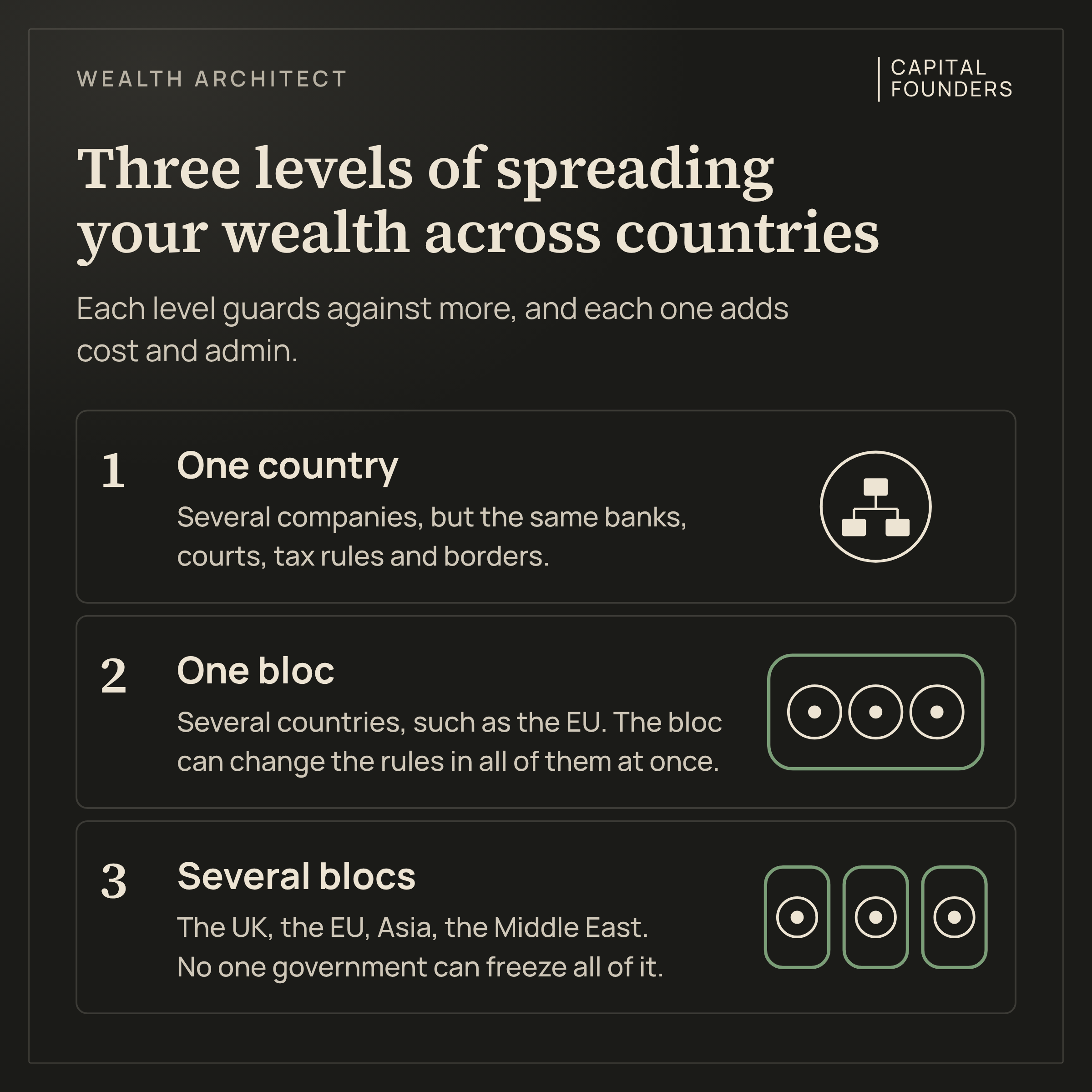
Three levels: one country, one bloc, several blocs
There are also different levels of diversification.
- In your home country, you can use several companies, but they all depend on the same banks, courts, tax rules and borders.
- If you use several countries inside one bloc, such as the EU, you don't depend on one country's banks or politics. But the bloc can change the rules in all of them at once.
- With countries in different blocs, say the UK, the EU, Asia, and the Middle East, no single government can freeze all of it.
In February 2022, the EU changed one rule in all its member states at once. From the 26th, Russian citizens and residents couldn't deposit money at an EU bank if it would take their total at that bank above €100,000. Russians who were also EU citizens, or had the right to live in an EU country, were exempt.
I think it makes sense to diversify your banking partners: not only different banks in the same country, but better still, different banks in different jurisdictions and geopolitical regimes.
What spreading across countries costs
With each company, custodian or bank account you add, you take on more identity checks, statements, tax forms and fees. If you hold investments abroad, you may also pay local costs, such as Switzerland's stamp tax.
Jan Voss of Cape May Wealth writes for families with €5m to €25m. If you have about €10m, he usually wouldn't advise setting up a company abroad, especially if you don't need to protect against a particular risk.
It really depends on your situation and complexity, and what you are trying to achieve. For example, if you have family ties in another country, getting residency, a passport, or a second bank account there might be easier and worth it just in case.
That would be different if it's a totally new country for you, where you need to start from scratch. So think of what you want, plan for different scenarios, and then decide on a minimum viable setup.
Jan also warns against moving just for tax unless you'd be happy living there anyway. He gives the example of people who left Germany for a Mediterranean island to save on taxes and now have to spend half the year there.
Having different bank accounts or passports is not about hiding things or secrecy. It's about having options when things happen in your home country (or primary residency). Your tax office at home usually hears about accounts abroad anyway (more in What I'm Reading).
Keep all the information in one place, keep your records in order, and share it with your family and those close to you. If you fell ill or died, they'd need to know what exists, where it is and who to call.
A 10-minute check of your banks, home and documents
Take 10 minutes this week to write down three answers.
- Name the country that holds most of your assets, and check whether your main bank accounts and your home are there too.
- Work out whether you could pay your bills from somewhere else for 3 months if its banks and borders closed tomorrow. Count only accounts in your own name that you've used and can reach from abroad.
- Check whether the papers you'd need are together and ready to go (passports, residence cards, company documents and account details), and whether your family knows where they are.
If the answer to 2 or 3 is no, that's the place to start.
I'm not saying everyone needs second or third passports and private bank accounts worldwide, like James Bond. But I think it's important to understand all the risks, and today geopolitics poses so many threats. It's better to think ahead, be prepared, and have a plan B if anything happens.
If nobody has answered your money question directly, reply, and the best ones go into the December edition.
Everything here is free. Subscribing just tells me the content is useful — and helps me decide what to write next.
What I'm Reading
If you have an account abroad, an HMRC letter may now name the bank that reported it.
Buzzacott, a UK tax firm, says several of its clients have had HMRC letters lately naming the bank that sent in their details, how much it reported and for which tax year. A bank abroad usually reports your account to its own tax office, which passes the details to yours (this is the OECD's Common Reporting Standard). So your tax return needs to match the bank's figures. Read more →
If you raised at the 2021–22 peak, a sale now may fetch a fraction of that price.
Airtable was valued at $11bn at the end of 2021 and sold in August for $1.28bn. Miro, valued at $17.5bn early in 2022, agreed last month to sell for about $1.36bn. Investors in rounds like those usually hold preferred shares, which get paid back first, so the lower the price, the less is left for you and your team. If your last round was in that boom, ask your CFO or lawyer what you'd take home at today's price. Read more →
On 21 October, attackers hid password-stealing code in LiteLLM, an AI tool many developers use.
For a few hours, a new version carried code that tried to steal passwords and keys from any machine it was installed on. If you installed it, LiteLLM says to reinstall from a clean copy where you can and change every password and key that machine had access to. So when you try an AI tool for the first time, use a spare laptop with nothing financial on it. Read LiteLLM's notice →
California votes on 3 November on a tax on billionaires who lived there on 1 January.
Proposition 40 would charge Californians with $1bn or more a one-off tax of up to 5%. It counts anyone who lived there on 1 January 2026 and values their wealth at the end of 2026. A billionaire who has left since January will still pay if it passes. If you're weighing a move, a rule like this can set the cut-off before anyone votes. Read Baker Tilly's summary →
New on the Site
The 26 May Signal looked at the Britons who had moved to the UAE. Around 30,000 left between February and April this year, and most couldn't afford to come home, because the UK's tax changes of April 2025 had closed that route. If moving for tax has ever crossed your mind, read it next to this week's memo.
Read it: Tax Wasn't the Risk You Bought
This was Capital Signals — weekly briefings on what's reshaping founder strategy on wealth.
Go deeper: Playbooks · Wealth Architecture · Investment Strategy · Business Building · Life Design
Found this useful? Forward it to a founder who's thinking about this stuff. Got a question or disagree with something? Get in touch.
New here? Subscribe for one email a week.


